Karen Glaser
(Editor at Terrorism and the Economy)

Copyright: http://www.homelandsecuritynewswire.com

Publication in RIEAS web site (www.rieas.gr) on 10th December 2016

A new study examining the roles of American jihadi women and found a significant increase in their participation in terrorist activity in the past five years. Within the wider movement, American women served primarily as plotters, supporters, and travelers. While few female American jihadists appear to act alone or carry out violent plots, many support activities along with friends, siblings, and romantic partners. The women are active online and offline, and social media use is common. Read more
Rukmini Callimachi
(Author, Asharq al-Awsat, Saudi Arabia,.London)

Copyright: http://english.aawsat.com/

Hyderabad, India — When ISIS identified a promising young recruit willing to carry out an attack in one of India’s major tech hubs, the group made sure to arrange everything down to the bullets he needed to kill victims.For 17 months, terrorist operatives guided the recruit, a young engineer named Mohammed Ibrahim Yazdani, through every step of what they planned to be ISIS’ first strike on Indian soil.They vetted each new member of the cell as Yazdani recruited helpers. They taught him how to pledge allegiance to the terrorist group and securely send the statement. Read more

Kyle Orton
(Author)

Copyright: The Henry Jackson Society (UK) – www.henryjacksonsociety.org - Publication on RIEAS web site (www.rieas.gr) on 26 March 2017.

Terrorist attacks by the Islamic State (IS) around the world have, since IS established its "caliphate" in Iraq and Syria in June 2014, become an increasingly regular feature of the international news landscape. But IS began its efforts to conduct foreign attacks before that, with several plots discovered earlier in 2014, and a trail of violence in Europe and beyond back to 2002, when IS had entered Iraq and the United States had not. Read more

Shaul Shay
(Security Analyst and RIEAS Research Associate)

Copyright: Research Institute for European and American Studies (www.rieas.gr) Publication date: 21 April 2017

Note: The article reflects the opinion of the author and not necessarily the views of the Research Institute for European and American Studies (RIEAS).

The Mary Girgis church in Tanta and Saint Mark's church in Alexandria were attacked on Sunday, April 9, 2017, as the Coptic Christian community celebrated Palm Sunday, one of the holiest days of the Christian calendar. The total number of casualties in the two attacks climbed to 47 dead and 126 injured, in the deadliest militant attack in Egypt against civilians in decades. Read more

Emily Boulter
(Writer based in the Netherlands. She is the creator of the current affairs blog “From Brussels to Beirut”. From 2010 -2013 she worked as an assistant to the Vice-chair of the Foreign Affairs Committee in the European Parliament)

Dr. Tamir Libel
(Beatriu de Pinós Research fellow at the Barcelona Institute of International Studies (IBEI).

Copyright: www.ejpress.org – Publication in RIEAS web site (www.rieas.gr) on 10 July 2017

The attacks in London, Paris and Brussels which took place in June were added to a seemingly endless list of terror attacks in which crude tactics are used to maximum effect. As Europeans come to terms with the growing terror threat, many politicians and members of the security services have stressed the challenges of predicting and preventing the actions of self-motivated individuals or lone wolves. However there is evidence to suggest that the problem may be less intractable, as outside Europe measures are being adopted, which are producing results. Read more

Shaul Shay
(RIEAS Research Associate and Security Analyst)

Copyright: Research Institute for European and American Studies (www.rieas.gr) Publication date: 28 July 2017.

Note: The article reflects the opinion of the author and not necessarily the views of the Research Institute for European and American Studies (RIEAS).

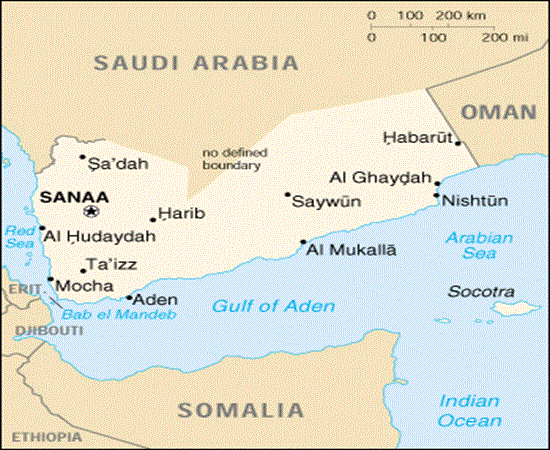
The Bab al-Mandab strait , which is 25 kilometers wide, is a strategically vital maritime waterway, through which merchant ships in the Gulf of Aden sail to the Red Sea, and then to the Suez Canal and the Mediterranean Sea. It is one of the most crowded waterways for oil transportation in the Middle East and other regions with more than 3.3 million oil barrels per day. This strait is vitally sensitive, not only to all countries bordering the Red Sea, but to the world trade as a whole. Read more